Saturday, February 8, 2020
FEB 7 TINY EUROPEAN NATIONS THAT ARE UNRECOGNIZED BY THE U.N.
For 75 years, Eastern Europe was simple. It consisted of eight, easy-to-remember countries. The Fall of the Iron Curtain in 1991 resulted in dozens of new nationalities bursting with pride. For example, after centuries of being controlled by the Ottoman Empire and then Yugoslavia, Croatians, Bosnians, Slovenes and Serbs now all have their own nations. However, for even smaller groups, the trickle-down to independence didn't arrive. Here are four miniscule countries that claim independence, but aren't recognized by the UN.
TRANS-DNIESTER. Officially part of tiny Moldova, this sleepy state sits on the banks of the Dneister River. Basically, these people refuse to acknowledge the USSR is gone. The Lenin statue is still in the town square. 1,500 goose-stepping soldiers march their Tiraspol's main square on Independence Day (Oct. 25). They have a sickle-and-hammer on their flag. Neighboring nations accept their passports, but no one else does.
ABKHAZIA. This Caspian Sea micro-state also claims independence, but few listened. Since antiquity, Abkhazia has appeared on maps. They have their own language and a culture that has withstood countless annexations. When placed in the borders of Georgia in 1991, the Abkhaz people refused to join. Instead, they forced out the 50,000 Georgians living there and hoisted their new flag. In 2008, Russia recognized their independence, but only Nicaragua has since.
SOUTH OSSETIA. Another group caught between Russia and Georgia is Ossetia. Hidden high in the Caucus Mountains, their unique civilization and language is Persian in origin. Today, the Northern portion lies in Russian territory, where it was granted autonomous status. Southern sections fell under Georgian control. In 2008, they declared independence, and fought a brief war. However, no one cared.
ARTSAKH. The scenic and jagged Caucus Mountains are home to 150 million people with a dozen different languages. Once part of the mighty Armenian Empire, the Artsakh province was cut-off from Yerevan centuries ago and surrounded by Azerbaijani people. In 1920, the USSR proclaimed the region the Nagorno-Karabkh Autonomous Oblast. In 1991, they were placed in the borders of the new nation of Azerbaijan. They've never accepted this and instead salute their silly flag.
NOTE: All four nations are members of the UNPO: The Unrepresented Nations and Peoples Organization.
Saturday, February 1, 2020
JAN 31 ALASKAN WOMAN IS FIRST PERSON COUNTED IN 2020 CENSUS
The 2020's are a month old. In the US, a new decade means our census is now underway. While ancient civilizations from Babylon to the Inca conducted counts, the USA was the first modern nation to formally do an official census. Thomas Jefferson insisted it be in our Constitution in 1787. Three years later, in 1790, the first US census occurred. There were 3,929,214 Americans.
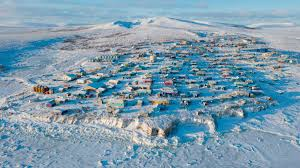
In the twenty-two censuses since then, the bureau has tinkered with new methods and procedures. One such change is to start counting people in the most remote...the most difficult places to get to...FIRST. Welcome to Toksook Bay, Alaska. It a tiny village on the frigid Bering Sea. It's only accessible by bush plane, dog sled or snowmobile. The residents are all Yupik people who have lived there for centuries.
Naturally, when the people in Toksook Bay discovered they would be the FIRST PLACE to be officially visited by the Census Bureau, they were ecstatic. Then the question arose: Who get to be the FIRST PERSON to be counted? Well, in Native American cultures, elders and ancestors are most prominent. And the oldest, wisest person in Toksook Bay is Lizzie Chimiugak, age 90. To be clear: Federal Privacy laws prohibit identifying any one individual in the census. Director Steven Dillingham only performed a 'ceremonial' first interview with Lizzie.
But what an interview it turned out to be! When born in 1930, the Alaskan Territory had only 59,000 people...almost all in Anchorage and Fairbanks. The nomadic Yupik were unaware of this when Lizzie was born in a mud hut...one of ten children. Her childhood involved cleaning fish, tanning hides and gutting seals. When permanent homes were built by the government in the 1950's, she married and moved in. She has five kids of her own.
After the ceremony, held in the Nelson Island Schoolhouse, the surprisingly spry Lizzie got up and danced with her community. But then, inquisitive journalists got involved and ruined the party and the feel-good vibe of this blog. Speaking through a Yupik translator, Lizzie confessed: She is worried about the future of Alaska. For 90 years, she's seen ice melt and miles of land exposed. For 90 years, she's watched the once abundant wildlife vanish. Sigh..
Saturday, January 25, 2020
JAN 25 US CELEBS ARE BECOMING CITIZENS OF AFRICAN NATIONS
The Ancestry Craze has taken over the USA! Using new tech, people can discover their ancestral past with just a simple oral swipe. It often leads to surprises. Just watch 'Finding Your Roots' on PBS. See, most Americans don't know their true ancestry. We are told we are descendants of French aristocracy or the Italian mafia, etc. as part of family lore. After receiving factual DNA results, we are flabbergasted to see we're actually 90% Slovenian or Lebanese and none of our cherished legends are likely true.
Yet perhaps the most revolutionary aspect of the Ancestry Craze involves African-Americans. At least other groups have an notion...an idea...of where they're from. But for the descendants of the 20 million African slaves brought to the New World, DNA data is a spectacular view into a previously unknown area. Here are three celebs who have embraced their African origins, visited their homelands and then became citizens:
SAMUEL L. JACKSON. (Gabon). This actor actually went on the PBS show and was fascinated to learn that his family is from the Benga People in Gabon. This led to Jackson researching and visiting his ancestral home in Africa. Turned out he loved it! He described his trip as a "journey of discovery." When he returned a year later, Jackson was hailed as a national hero. Gabon's "President" Ali Bongo was on hand and presented the 'Pulp Fiction' star with a shiny new Gabonese passport. Nice!
LUDACRIS (Ghana). The Atlanta rapper-turned-actor is also on the ancestry bandwagon and began researching his heritage. This work took Chris to Ghana. As the sole British colony on Africa's Gold Coast, Ghana is where the majority of the American colonies' slaves came from. As part of Ghana's "Year of Return" ceremonies, Ludacris was one of 125 other international artists of Ghanaian descent to receive citizenship. "I was not born in Africa, but Africa has been born in me." You go, Luda!
TIFFANY HADDISH (Eritrea). Although born in South-Central LA, this comedian's family are recent immigrants from East Africa. When her father passed away last year, Tiffany attended his funeral in Eritrea, his birthplace, for the first time. She was astounded with the natural beauty of the land and the hospitality of the people. Like Jackson, she was celebrated and feted by the government. She now proudly has dual US / Eritrean citizenship. Beautiful!
Saturday, January 18, 2020
JAN 17 NATIONS THAT FORBID ALCOHOL
One of America's most memorable days occurred one hundred years ago today. January 17, 1920, was the first day of Prohibition. From coast to coast, kegs of beer, casks of wine and barrels of whiskey were ceremoniously dumped into sewers. Thirteen years later, the moral experiment known as the 18th Amendment ended. Today, a handful of Islamic nations still have complete bans on alcohol:
KUWAIT. The Koran specifically forbids followers from consuming alcohol. Worldwide, 95% of Muslims don't drink. Grocery stores don't sell it, restaurants don't serve it. However, in most Islamic countries, non-followers of the Koran are allowed to drink. It is legal for businessmen and tourists to drink, so you'll see booze in airports and select hotels. This is not the case in Kuwait. Strict laws prohibit anyone from having even an ounce of liquor.
LIBYA. Prior to the arrival of Col. Gaddafi in 1969, Libya resembled the other Mediterranean countries. It was blessed with fantastic beaches, quaint coastal ports and phenomenal Greco-Roman ruins. Then the Green Book came and everything changed. Visitors and booze were suddenly forbidden. The current dictatorship has only wrenched up the policy.
SAUDI ARABIA. As the guardian of Mecca, it comes as no surprise that Saudi Arabia has most strict interpretation of Koranic law. Upon arrival, luggage is thoroughly searched. Bottles are confiscated and fines are levied. If you arrive drunk, you aren't allowed in. Once inside the Kingdom, the laws become even more severe. The punishment for selling alcohol? 500 lashes.
INDIA. Most of India has no restrictions on alcohol. However, there are two states that have such extraordinary ordinances they deserve mention. The states of Gujarat and Nagaland implement the death penalty for anyone caught manufacturing any form of booze. Yikes. Bihar recently also became dry, which is notable. With 103 million residents, if Bihar were an independent country it would boast the world's 13th largest population.
The remaining nations with outright bans on booze are: Mauritania, Somalia, Sudan and Yemen.
Saturday, January 11, 2020
JAN 11 CONFUSING TIME ZONES EXPLAINED
Happy New Year from the DUNER BLOG! Every New Year's Eve, the staff gets together at the San Francisco HQ to watch each time zone celebrate on the news. It starts at 3:00 am - that's when folks in Samoa light off the very first fireworks. At six, we watch Sydney Harbour awash in colour, then at ten o'clock it's Hong Kong Harbour. The real party starts at 9:00 pm, when the ball drops at Times Square, NYC. During the day, we discover some really curious time zones around the world. Here are five:
SAMOA: UTC +14:00. Up until the year 2011, Samoa was on the last nation to celebrate a new year. See, the island nation is only 100 miles west of the International Date Line. This causes Samoa problems, as they are a day behind their top business partner, Australia. The solution? Bend the date line. Together with neighboring Kiribati, they cancelled December 30th, 2011 and jumped a day forward.
INDIA: UTC +5:30. During colonial times, there were three time zones in India: Two, Bombay Time and Calcutta Time, were an hour apart. The third, Madras Time, is in between these two meridians. Therefore, it was a half hour off. This worked for sailors, but when railways crisscrossed India it became a problem. People didn't know if a train was on Bombay, Madras or Calcutta time. So it was decided India would have ONE time zone. Logically, the one in the middle was the one selected. A nation is allowed to choose their time zone, and it's stuck around ever since.
NEPAL: UTC + 5:45. Travelers joke it's best not to observe India's half-hour time zone. Why? Because Indians are always thirty minutes late! So does that mean that the Nepalese...the only country in the world with a 45 minute increment...are even later than Indians?? Nope. It's because the Kingdom has always set their watches around when it's noon at Gaurishankar, a sacred Himalayan peak.
CHINA: UTC + 8:00. The People's Republic likes things uniform, so it comes as no surprise they too only have one time zone. The problem is that the PRC is much larger than India. For comparison, the 48 contiguous US states is the same size as China. However, we have four time zones. As expected, one gigantic time zone creates odd occurrences. For example, in summer, the sun sets a midnight in Xinjiang. As a quiet protest, the Uighur people who live there use common sense and adhere to their actual time zone.
NEWFOUNDLAND: UTC -3:30. The Western Hemisphere has surprisingly normal time zones, logically following lines of latitude. Except for Newfoundland. Like India, they are a half hour off. It too dates to the British colonial period, when the ports of St. John's were thirty minutes ahead of Quebec. When time zones were first drawn up in 1885, Newfoundland was not part of Canada and chose to keep their zone. The independent-minded colony was the last province to join Canada in 1933. Despite pressure from Ottawa, they grudgingly keep their odd time zone.
Sunday, December 22, 2019
DEC 21 MACAU CELEBRATES 20 YEARS OF CHINESE RULE
Unless you've been living under a rock all year long, you've heard about the protests in Hong Kong. For the last six months, a million people have taken to the streets to protest the People's Republic of China's ridiculous 'One Country, Two Systems' policy of rule. Yet a mere 65 kilometers away in Macau, this same system is thriving. This was evident yesterday, with President Xi on hand to celebrate the 20th anniversary of the handover.
Although not nearly as famous as her colonial cousin, Macau is actually much older. It was established in 1513 by Portuguese explorer Jorge Alvares...300 years before the British first sailed into Hong Kong Harbor. However, while England instituted positive policies in Hong Kong, like Common Law and self-rule...the Portuguese were different. Macau existed only as a trading center. While enterprising Brits flocked to Hong Kong, only a handful of Portuguese citizens moved to Macau.
This disparity was also on display when the two colonies were returned to the PRC in the 1990's. Hong Kong witnessed a mass migration back to the UK, with many corporations relocating as well. Meanwhile, folks in Macau welcomed the Chinese with open arms. Neglected by Lisbon for 442 years, the colony had slid economically, with a below average standard of living.
Things have changed dramatically. Today, Macau bests the third highest GDP worldwide, trailing only Luxembourg and Switzerland. How did this occur? Mega-casinos, that's how! For decades, Macau was a tough and seedy port city, lined with bars and taverns. At the heart of this was the Casino Lisboa. When the PRC took over in 1999, they decided to develop the gaming industry and the results have been stupendous.
In short, the lessons learned by the two SAR's (Special Administrative Regions) is simple. Once the seed of liberty is planted, it grows. Hong Kong was granted Common Law and individual freedoms by the British. Two centuries later, citizens refuse to give them away. However, four centuries of oppressive Portuguese rule in Macau resulted in acrimony and a desire to change. Today, the only signs of Portuguese rule are a handful of Catholic churches and street names.
Saturday, December 14, 2019
DEC 14 SAUDI ARABIA GIVES WOMEN MORE RIGHTS
The Kingdom of Saudi Arabia lifted another restriction regarding women's rights. On Monday, a press secretary for Crown Prince Mohammad bin Salman announced that Saudi restaurants will no longer be required to have separate entrances for men and women. Instead of the government mandating the policy, gender separation will be up to the businesses themselves. It's big news: Now families and couples can sit at the same table when they go out to eat.
The move is one of many sweeping reforms instituted by the rigid Middle Eastern nation. Although King Salman al Saud is still on the throne, the 84 year-old monarch is too old to rule. Hence, he named his first-born son with his third wife as regent in 2017. Since then, the 34 year-old Mohammad bin Salman has instituted numerous social reforms in the ridiculously conservative country.
Last year, the Crown Prince received praise when he lifted the ban on women driving cars. Mohammad bin Salman surely must have read the DUNER BLOG on the issue and acted accordingly. In the year since, driving schools have been busy: Over 30,000 women have passed the test and are on the road. Also important: The Prince pardoned the women activists who were arrested for driving cars in protest.
In his two years as regent, Crown Prince Mohammad has instituted a flurry of social reforms. It's clear: he is trying to put men and women on more equal footing. In July, he lifted a much criticized ban as well. Saudi Women can now travel abroad without permission from their male guardian. Any woman over 21 can receive a passport. Likewise, women can now register themselves for marriage and divorce on their own.
We here at the DUNER BLOG cheer Crown Prince Mohammad bin Salman for reading our blog and reforming his outrageously conservative country. But let's not forget: He still has a long road ahead of him. On the UN's Gender Inequity Index, Saudi Arabia remains in the bottom ten. Women can drive a car, but they can't live alone nor can they open a bank account. Let's hope the new Crown Prince is an enlightened despot with good in his heart...and not just a worried monarch trying to grab some positive press after the shameful Khashoggi murder.
Subscribe to:
Posts (Atom)